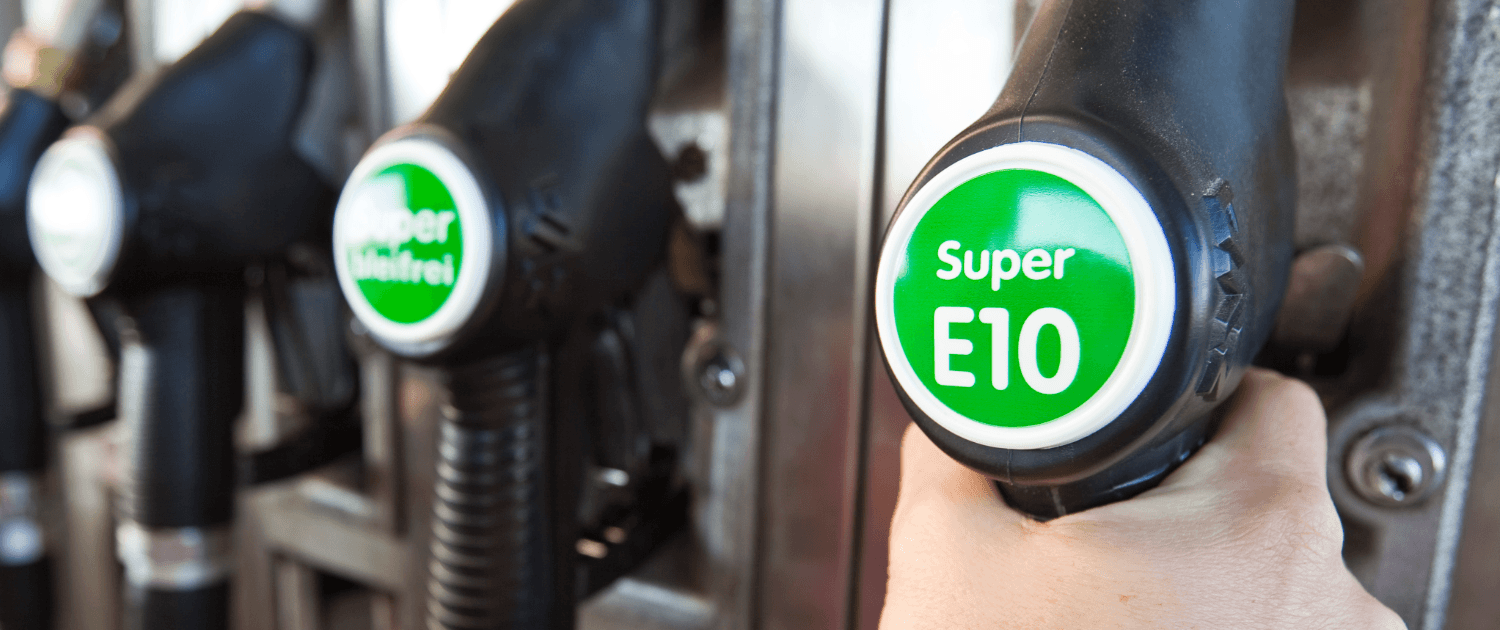
What is the difference between unleaded and super-unleaded
The primary difference is that standard unleaded possesses 95RON and super unleaded is rated at least 97RON. Standard unleaded is also blended with up to 10% ethanol; super unleaded contains up to 5% ethanol.
What does RON mean?
RON means Research Octane Number. It is a measurement of a fuel’s ability to burn smoothly in a petrol engine without detonating. This explosion sounds similar to a metallic rattle and is also known as ‘pinking’, ‘pinging’, or ‘knock’. It may not sound severe but fuel that explodes uncontrollably, rather than burning smoothly, can cause severe engine damage, including holed pistons and pitted valves.
As it can be so harmful, modern engines possess ‘knock’ sensors that make adjustments but result in a loss of power.
Therefore, there is the potential for higher octane fuels, such as Super Unleaded, to release more power from an engine, especially if it is turbo, or supercharged.
E10 vs E5 petrol
E5 refers to petrol that contains up to 5% ethanol. E10 contains up to 10%. Some countries possess higher percentages, such as E20 (up to 20% ethanol), E85 (up to 85% ethanol) and E100 (pure ethanol).
You might think that ethanol, being a renewable fuel grown from crops, is relatively harmless. The opposite is true. While these downsides tend not to be a problem with the low concentration of ethanol used for E5, the risk of the following issues rises considerably, when the percentage of ethanol rises above 5%.
Will my fuel consumption increase, using E10 petrol rather than E5?
Like-for-like, yes. As E10 petrol contains less energy than E5 fuel of the same octane rating, fuel consumption increases by around 1-2%. This is according to the UK’s Department of Transport.
A justification for more frequent servicing is that more ethanol in petrol increases the deposits produced, which the oil must carry. For more advice on engine oil, consult this blog.
Does E10 petrol go off quickly?
The first problem is that, being a foodstuff, ethanol goes stale. While all petrol ages, E10 petrol deteriorates faster than either pure fossil-fuel petrol, or even E5, thanks to its elevated oxygen content.
With E10, it has been found that significant ageing can begin within two weeks of ethanol being blended with petrol at the refinery.
Just like eating food past its use-by date, expecting an engine to run on old E10 petrol has consequences. Not only will the engine produce less power but also the fuel will not burn cleanly.
This can result in deposits building within both the engine and its fuel system. These accumulations reduce efficiency and reliability but increase fuel consumption and exhaust emissions.
A further issue is that the ethanol content within the petrol absorbs moisture. Once this reaches a critical point, the water/ethanol mix drops out from the petrol.
The incombustible deposit at the bottom of the tank that results from this phase-separation can cause non-starts, or running issues. The remaining low-octane petrol above it will also ensure the engine does not run properly.
Fortunately, you can buy additives to pour into the tank that reduce the rate of ageing, if you do not tend to refuel your car at least monthly. Alternatively, you can use E5 fuel.
These tips are also useful for your gardening equipment, although many professionals prefer to use E5.
Can I put E10 petrol in any car?
No. Ethanol attacks certain rubbers and plastics and corrodes some metals such as brass, copper and aluminum. Therefore, certain cars are not compatible with E10 petrol, because the materials used within their fuel systems will be damaged by the fuel.
E10-compatible cars contain materials that can resist the ethanol within E10. As a guide, pre-2002 cars cannot use E10. Yet, some models from the 1970s can use it.
To find out, contact your car manufacturer for clarification but consider that the UK Government has published a useful online checker that is free to use: www.gov.uk/check-vehicle-e10-petrol .
Can classic cars run on E10 fuel?
According to the Department of Transport, E10 is likely to corrode carburettors, block fuel filters, damage pumps and cause further issues with flexible rubber-based fuel hoses.
It is best to check with marque specialists, or those with in-depth knowledge of specific fuel systems. Some carburettor specialists provide spare parts that are made from E10-resistant materials, such as Viton rubber.
Yet, when working on fuel systems, consider that some blends of replacement rubber fuel hose are not ethanol-resistant. These degrade quickly with E10 and even some E5 fuels, increasing the risk of fuel leaks and fires.
To be sure, ensure that all replacement rubber complies with SAE J30R9 (or ‘R9’) and is sourced from a reputable supplier. We have heard of counterfeit R9 hoses being sold on online marketplaces that are incompatible with ethanol, so be careful.
Consider also that E10 fuel causes engines to run on a comparatively weaker fuel/air mixture, compared with E5. Modern fuel injection systems compensate automatically but older cars may require manual carburettor adjustments.
This advice is also valid for garden machinery, such as petrol-powered strimmers, or chainsaws.
What happens if I accidentally fuel my car with E10?
Unlike tanking a petrol car with diesel, E10 misfuelling consequences are neither as instant, nor as severe. Therefore, it is unlikely that extra safeguards, such as misfuelling insurance cover, will be necessary.
Yet, ethanol will start attacking materials immediately. If you notice that you have used the wrong fuel, stop immediately and fill the tank with E5.
Consider also that using a fuel with the wrong octane rating can cause damage more quickly than ethanol. Should you misfuel the car, you may need to adjust the engine’s fueling and ignition settings.
What help do I need with E10 fuel?
Should your car suffer from the effects of elderly E10 fuel, by not starting, or not running properly, then GEM can help. Additionally, if you use the wrong fuel,
including that with an incompatible RON, GEM can perform the necessary adjustment to get you on your way.
Therefore, GEM echoes ADAC’s advice: only use E10 petrol on cars that are designed to use it. You can look up your car on this list to see if it is compatible:
GEM Motoring Assist is a members’ motoring and road safety organisation in the UK. Our aim is to keep our members on the move… whether that’s through our breakdown recovery service or our motoring and road safety expertise.
Join GEM for simple and straightforward, all-inclusive personal breakdown cover.
We use essential cookies to ensure our site is safe and works properly. We also use analytics cookies to offer you a more personalised experience and to improve our site. To find out more and manage your cookie preferences, please choose ‘Manage’ to view our cookies policy.
This Cookies Policy sets out how GEM Motoring Assist (“We”), use cookies on this website.
About Cookies
A cookie is a small file that is downloaded to a device (e.g. a Computer, Tablet or Smartphone) when a website is visited. The cookie allows the website to recognise a user’s device and store information based on the user’s previous actions and preferences.
For a complete definition of cookies, please visit the Information Commissioner’s Office (ICO) website here.
Types of Cookies used
Essential Cookies
The table below explains the essential cookies We use and why.
Provider
Cookies
Purpose
GEM Motoring Assist
__RequestVerificationToken
This cookie is used to protect against Cross-Site Request Forgery (CSRF) attacks. This is set when you visit the page and is sent back to Our server whenever you submit a form in order to ensure any form submissions originated from Our site.
gemcl
We use security cookies to authenticate users, prevent fraudulent use of login credentials, and protect user data from unauthorised parties.
gem_aggr
This cookie is used to attribute your purchases with our partners.
gem_discount
This cookie is used to ensure customers receive discounts when purchasing through online advertisements.
_cookieconsent
This cookie indicates preference for the use of non-essential cookies.
Application Insights
ai_user ai_session
These cookies are used to collect information about issues, dependencies and exceptions which may occur when browsing this website. This data is purely for telematics and error detection, triage and diagnoses. For more information click here.
Analytics Cookies
The table below explains the analytics cookies We use and why.
Provider
Cookies
Purpose
Google Analytics
_ga _gid _gat AMP_TOKEN _gac_ <property-id>
Used to distinguish users. Used to distinguish users. Used to throttle request rate. Contains a token that can be used to retrieve a Client ID from AMP Client ID service. Contains campaign related information for the user. For more information on the use of Google Analytics Cookies please click here.
How to control Cookies
Information on controlling cookies using specific web browsers can be found on the Information Commissioner’s Office (ICO) website here.
Changes to our Cookies Policy
Any changes We may make to Our Cookies Policy in the future will be posted on this page. We advise that you check this page regularly to keep up to date with any necessary changes.